Real-Time Athlete Tracking Systems Transforming Professional Sports Strategy
- David Bennett
- Dec 8, 2025
- 5 min read

Real-time athlete tracking has become one of the most transformative technologies in modern sports. Professional teams across football, basketball, soccer, cricket, baseball, tennis, athletics, and emerging sports rely on live movement analytics to understand player behavior, manage load, increase tactical precision, and optimize performance. Instead of depending solely on traditional scouting or video review, teams now use tracking systems to capture precise positional, physiological, and biomechanical data during training and competition.
This shift has reshaped sports strategy at every level. Coaches gain immediate insights into decision making, spacing, dynamics, acceleration, fatigue, and tactical patterns. Analysts can break down plays with far greater accuracy. Athletes receive objective feedback tied to their performance and movement efficiency. Tracking systems help predict injury risk, measure player effort, and refine strategy with unprecedented detail.
This article explores how real-time athlete tracking systems transform professional sports strategy, why they matter, and how modern teams integrate them into daily performance workflows.
Table of Contents
What are real-time athlete tracking systems?
Why are professional teams adopting tracking technologies?
How does tracking data improve tactical strategy?
Understanding movement patterns and positioning
Speed, acceleration, and reaction analytics
Load management and injury prevention
How does tracking enhance individual player development?
Integration with VR and simulation-based training
Using tracking data to inform scouting and recruitment
Challenges teams must consider
Conclusion
FAQs
What are real-time athlete tracking systems?
Real-time athlete tracking systems use sensors, cameras, positional markers, GPS units, LPS antennas, or computer vision to measure how athletes move on the field. These systems capture:
positioning
sprint speed
deceleration
heart rate data
fatigue markers
directional changes
reaction timing
biomechanical loads
Because Mimic Sports focuses on immersive and analytical performance technologies similar to those highlighted on the Mimic Sports homepage, tracking systems naturally complement the brand’s broader ecosystem of spatial and VR-based training tools.
Tracking data becomes the foundation of evidence-based coaching.
Why are professional teams adopting tracking technologies?
Teams want accuracy and consistency across training and match environments. Tracking technologies provide:
objective performance measurement
tactical visibility across entire plays
stronger athlete monitoring
injury risk prediction
data-driven decision making
competitive advantage in analysis
Tracking systems remove guesswork and reveal patterns that coaching staff cannot see with the naked eye.
How does tracking data improve tactical strategy?
Strategy becomes much sharper when movement is quantified .Tracking systems help coaches understand:
how formations hold against pressure
how players respond during transitions
how quickly athletes enter tactical zones
spacing efficiency during attack or defense
tendencies when under fatigue
where breakdowns occur in real time
This transforms strategy from theoretical to measurable.Teams can adjust tactics based on evidence instead of assumptions.
Understanding movement patterns and positioning
Movement patterns are essential for team flow. Tracking systems break down:
off-ball movement
defensive rotations
passing lane availability
zone occupation
marking efficiency
timing of cuts or runs
When tracked over time, these patterns reveal habits, weaknesses, and opportunities for refinement.
This data-driven awareness strengthens coaching decisions and accelerates athlete improvement.
Speed, acceleration, and reaction analytics
Acceleration and reaction performance separate elite athletes from average performers. Tracking systems capture:
first step quickness
peak speed
acceleration curve
deceleration control
turning ability
delayed reactions under fatigue
These metrics highlight athletic capabilities and pinpoint areas for improvement.
Reaction speed insights pair naturally with immersive training methods described in VR sports training systems, where VR is used to simulate rapid decision making and high pressure scenarios.
Load management and injury prevention
One of the biggest advantages of tracking systems is injury prevention.By monitoring internal and external load, teams can reduce risk and tailor recovery.
Tracking can identify:
overuse indicators
asymmetrical movement
fatigue based decline
irregular gait patterns
muscle imbalance
high stress movement cycles
Injury risk prediction allows coaches and medical teams to adjust training intelligently.
This keeps athletes healthier across long seasons.

How does tracking enhance individual player development?
Athlete tracking provides precise data that helps coaches design personalized performance plans. Players receive insights into their:
movement inefficiencies
speed thresholds
stamina capacity
recovery speed
reaction consistency
positional tendencies
Development becomes more structured and measurable.
Tracking transforms feedback from subjective to objective, helping players trust the process more deeply.
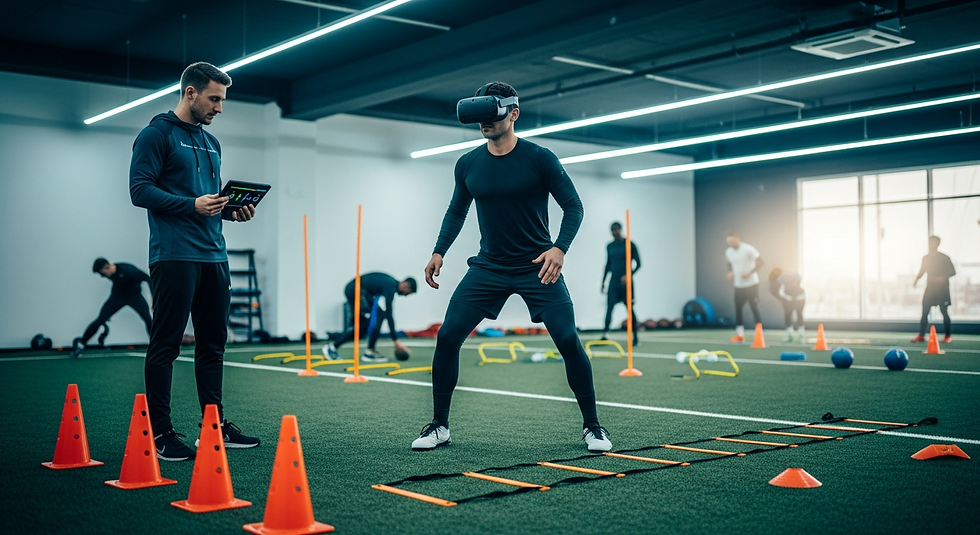
Integration with VR and simulation-based training
Tracking systems pair extremely well with VR and simulation environments. By importing positional and movement data into VR platforms:
players rehearse real game patterns
teams visualize opponent behavior
coaches demonstrate spacing concepts
athletes relive key moments in first-person view
training becomes more realistic and impactful
Tracking data and VR synergy make learning more experiential.
This integration aligns closely with the immersive philosophy behind Mimic Sports, where real-time movement and simulation technology work together.
Using tracking data to inform scouting and recruitment
Tracking systems give organizations a more accurate view of athlete capability.
Recruiters examine:
game speed instead of track speed
work rate during pressure
change of direction under stress
tactical intelligence
movement economy
effort consistency
This ensures decisions are based on real performance rather than isolated drills or subjective evaluation. Teams can identify undervalued players and avoid risky signings.
Challenges teams must consider
Tracking systems offer immense value, but teams must plan for:
data overload
interpretation accuracy
privacy and compliance
player comfort
hardware maintenance
consistent calibration
integration into coaching culture
Success depends on blending data with coaching intuition.

Conclusion
Real-time athlete tracking is transforming professional sports strategy by giving teams a deeper understanding of movement, decision-making, effort, and performance patterns. Tracking systems sharpen tactics, reduce injuries, accelerate development, and create measurable improvement across entire organizations. As tracking integrates more closely with VR, simulation, and real-time analytics, the future of sports performance will be more intelligent, predictive, and personalized.
Mimic Sports helps teams adopt immersive and data-driven training methods that elevate performance across every position, from tactical understanding to reaction speed and physical decision making.
FAQs
1. What do athlete tracking systems measure?
They track position, speed, acceleration, reactions, fatigue, and biomechanical load.
2. How does tracking improve strategy?
It reveals spacing patterns, tactical gaps, transitions, and real-time decision behavior.
3. Can tracking help predict injury risk?
Yes. Load monitoring and movement analysis reveal early warning signs.
4. Do players improve reaction speed through tracking?
Tracking provides data that helps design drills for faster reaction development.
5. Is tracking used only in games?
No. Teams use it in training, rehab, scouting, and tactical study.
6. Can tracking integrate with VR?
Yes. VR simulations use tracking data to recreate game scenarios.
7. Are tracking systems accurate?
Modern systems offer extremely precise spatial and movement analysis.
8. What sports use tracking technology?
Football, basketball, soccer, cricket, baseball, tennis, and many others.


Comments