How Virtual Reality Sports Training Improves Athlete Performance and Reaction Speed?
- David Bennett
- Dec 8, 2025
- 5 min read
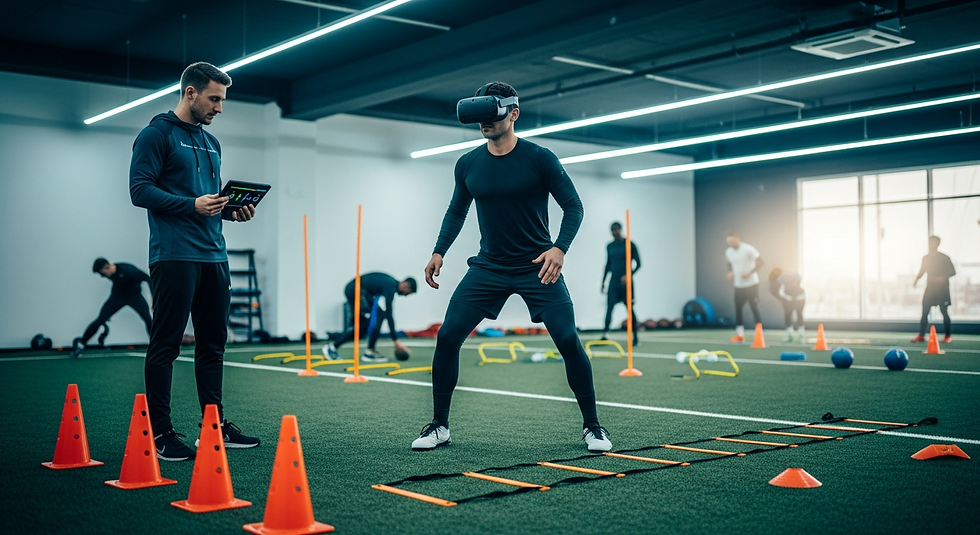
Virtual reality sports training has rapidly become one of the most valuable tools for athletes, coaches, and performance specialists. Instead of relying only on drills, repeated scrimmages, or analysis based on 2D footage, VR allows athletes to step inside true-to-life simulations where movements, decisions, and reactions can be practiced at full intensity without the physical risk of overtraining.
VR training environments recreate game speed, opponent behavior, timing windows, pressure scenarios, and spatial reads that athletes face in real competition. The result is a training method that strengthens cognitive sharpness, decision-making, reaction speed, and situational awareness. As VR technology becomes more advanced, sports organizations are integrating it into their training programs to gain consistent, measurable improvement.
This article explores how virtual reality sports training improves athlete performance and reaction speed, how teams use VR across different sports, and how next-generation systems, such as those powered by Mimic Sports, elevate modern athletic development.
Table of Contents
What is virtual reality sports training?
Virtual reality sports training places athletes inside immersive environments that replicate real competition scenarios. Instead of only studying film or practicing on the field, athletes practice inside 3D simulations that reflect authentic game dynamics.
VR sports training includes:
reactive drills
opponent decision training
tactical walkthroughs
positional simulations
timing and rhythm exercises
movement pattern review
strategy visualization
It gives athletes a safe and repeatable way to strengthen their mental and physical performance.
Why are athletes and coaches adopting VR training?
Traditional training methods are effective but limited by:
fatigue
injury risk
field and facility availability
inconsistent practice conditions
variable opponent intensity
mental burnout
limited reps in high-pressure situations
VR removes these limitations by offering:
unlimited repetitions
no wear and tear
consistent, controllable scenarios
instant feedback
high-pressure simulations
individualized training sessions
Coaches gain more control, and athletes maximize improvement without overworking the body.
How does VR improve reaction speed and cognitive readiness?
Reaction speed relies on perception, prediction, and immediate decision-making. VR strengthens these elements by placing athletes in fast, realistic scenarios that require quick responses.
VR improves reaction speed by:
exposing athletes to rapid visual cues
training under game-like pressure
forcing quick tactical decisions
accelerating the brain’s anticipation ability
reinforcing correct reaction patterns
Athletes learn to read situations earlier, respond faster, and commit fewer hesitation errors.
Realistic simulation of game speed and spatial dynamics
Game speed is one of the hardest things to replicate in normal training. VR places athletes inside:
high-tempo situations
aggressive defensive pressure
crowded spatial layouts
unpredictable opponent behavior
fast transition moments
This builds comfort with real-time spatial reads.
VR also helps athletes understand:
position relative to opponents
passing or shooting lanes
correct movement angles
spacing control
timing windows for action
Spatial awareness improves significantly when athletes practice inside real-scale simulations.
Skill repetition without physical strain
Overtraining is a major issue in competitive sports. Physical repetition leads to fatigue, injury risk, and decreased performance quality.VR solves this by letting athletes rehearse skills mentally and visually without physical overload.
Athletes can practice:
plays
footwork
tactical reads
pressure responses
decision sequences
predictive movement
without exhausting joints, muscles, or tendons.
This is especially useful for:
veteran athletes managing workload
in season players recovering between games
youth athletes still developing physically
VR creates a training environment where the brain works intensely while the body rests.

Improving confidence under pressure
Athletes often struggle with pressure, especially in high stakes moments.
VR simulates pressure so athletes can practice:
game winning situations
hostile crowd environments
high intensity opponent pressure
time restricted decisions
momentum swings
defensive traps
late game tactics
By facing these scenarios repeatedly, the brain begins to treat them as familiar.Confidence grows, hesitation fades, and clutch performance improves.
VR for sport-specific decision making
Different sports require different types of cognitive speed.
Football
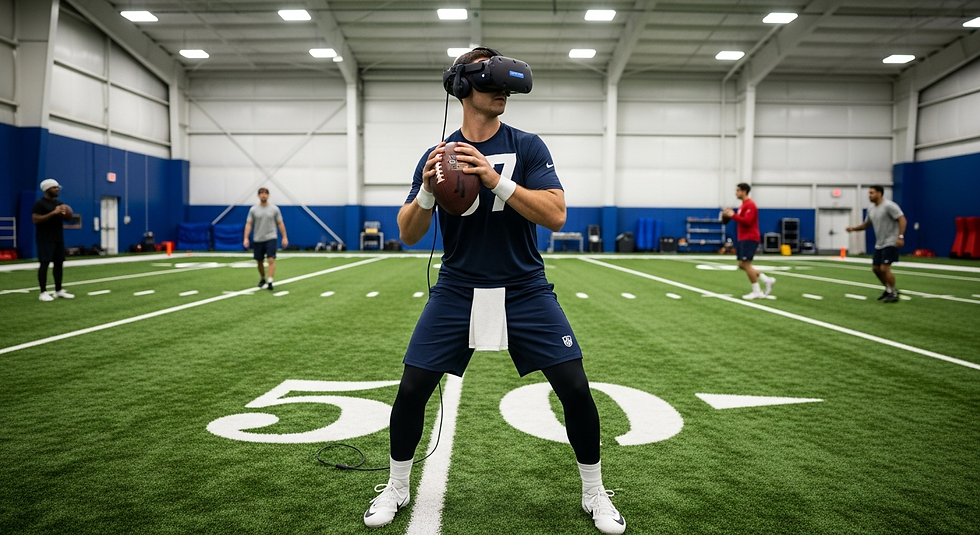
Quarterbacks read defensive formations, safeties, and blitz patterns.
Basketball
Players anticipate cuts, screens, spacing, and passing lanes.
Soccer
Midfielders scan space, observe pressure, and time through balls.
Baseball
Batters practice pitch recognition and timing.
Tennis
Players anticipate opponent movement and ball trajectory.
VR allows sport-specific decision drills that simulate the true mechanics of each position.
Decision-making becomes sharper, faster, and more accurate.
Strengthening pattern recognition and prediction
Elite athletes do not just react. They predict.
VR helps train prediction by:
showing repeated pattern cycles
simulating opponent tendencies
varying patterns to train adaptability
increasing pattern speed over time
helping athletes anticipate movement before it happens
This turns reactive athletes into proactive ones.
Predictive ability is often the difference between good players and elite players.
Using VR for injury rehabilitation and safe return to play
During injury recovery, athletes lose access to full physical training.VR keeps them mentally sharp.
Rehab benefits include:
decision-making practice while healing
tactical understanding without movement
confidence rebuilding
reduced fear of return
early reaction training before physical clearance
VR accelerates readiness and reduces mental rust. Athletes return with stronger cognitive preparation and less hesitation.
Integrating VR into team and individual coaching workflows
VR becomes more powerful when embedded into training workflows.
Coaches use VR to:
review plays
rehearse opponent strategies
simulate game plans
evaluate decision-making
train younger players faster
expose teams to new tactics safely
For individual athletes, VR is a tool for:
technical refinement
pressure acclimation
positional specialization
mental rehearsal
Teams using VR complement on-field drills with immersive cognitive training, resulting in more complete athletes.
Challenges to consider
VR training requires:
proper calibration
comfort for athletes
accurate simulation design
clear coaching guidance
sport-specific modules
reliable hardware
progressive difficulty levels
When implemented thoughtfully, VR becomes a long-term asset rather than a novelty.
Conclusion
Virtual reality sports training improves athlete performance by sharpening decision-making, increasing reaction speed, building confidence, and reducing the physical strain of traditional practice. VR allows athletes to experience real game situations, high-pressure scenarios, and unpredictable opponent behavior in a controlled environment. For coaches and training staff, VR provides measurable, consistent, and customizable tools that support long-term athletic development.
Mimic Sports enhances these experiences by combining immersive simulation design, athletic performance insights, and advanced interactive technology to deliver next-generation sports training systems.
FAQs
1. How does VR improve athlete reaction speed?
VR places athletes in fast-paced simulations that train quick, accurate responses.
2. Does VR reduce physical strain during training?
Yes. Athletes practice decision-making without exhausting their bodies.
3. Can VR help with confidence under pressure?
Repeated exposure to high-pressure simulation reduces fear and hesitation.
4. Is VR useful for team strategy training?
VR can simulate plays, tactics, and opponent behaviors for entire teams.
5. Does VR help during injury rehabilitation?
Injured athletes can maintain cognitive sharpness and tactical readiness through VR.
6. Can VR be personalized for different sports?
Yes. Modules are designed for football, basketball, soccer, baseball, tennis, and more.
7. Do athletes need advanced VR skills?
No. VR training is designed to be intuitive and accessible.
8. Is VR becoming common in professional sports?
Yes. Many pro teams use VR to gain a competitive advantage.


Comments